Friday, May 29, 2009

Amazing Journey to Incredible India - DELHI (Part 1)

I think of so many places that I dreamed of going to and finally decided that I will explore India this time. Why? That’s the question we always heard of whenever we mention the trip. They say it’s not good there and we receive many more negative words. In spite of these we still go for it since India has a very diverse culture, with centuries old monuments and fortresses that is a must see before disappear on earth.
Indian women after a prayer at a popular mosque "Jama Masjid", New Delhi India.
Who would not want to visit one of the Seven Wonders of the World, the Taj Mahal for example? And for a photojournalist like me, exploring the streets of India is exposing you to a wide range of subjects and opportunities. Inspired also by the movie Slumdog Millionaire and Darjeeling Limited is the reason why we chose this place. I will be travelling with a companion, an engineer from GMA network, Mr. Randy Rondriguez.

This trip was not made overnight. We had a lot of preparation and brainstorming before we made the final booking of the plane tickets. We left Manila on a rainy Friday afternoon. Our plane is scheduled to fly at 2:30 PM but there are some delays so we have to wait. It was raining so hard that you might think it’s impossible for the plane to take off but Thai Airways proved that theirs is always smooth as silk. The Boeing 777 aircraft just flew like a bird in the sky. Just like a scene from the Amazing Race we have to rush through the boarding gate in Suvarnabhumi International Airport in BangkokThailand for us to get to our plane. A quick but strict inspection by the airport police and customs personnel and we are now heading to India. We arrived at Indira Ghandi International Airport in New Delhi after another four and a half hours of flying.
Even Local tourists visit the famous India Gate at Rajpath, New Delhi India.

Paddling through the waters of the holy Ganges River, rolling over the sand dunes of the Great Thar Desert in Rajasthan and climbing the snow capped mountains of the Himalayan mountain ranges, our adventure is simply quite amazing. We met strangers along the way and became friends with them.

Negotiating with india's railway station is one of the best experience in India. There are several trains traveling the country everyday and the railway system is the third largest in world.
The capital of India, Delhi, has a history that spans over several millennia. Site of no fewer than eight successive cities, it is the hub of the country, a buzzing international metropolis which draws people from across India and the globe. Situated at the nerve of the ancient Asian trade route, Delhi has accumulated extraordinary wealth, but repeatedly lost it to successive foreign invaders who have come knocking at the door. Tucked away inside Delhi’s modern suburbs and developments are tombs, temples and ruins that date back centuries ago.

Passengers cling to the door of a sleeper train at the Railway Station Connaught Place, New Delhi India.
Delhi has a wide range of transportation so going to other places is not that hard. You just have to be creative and not choosy. You can move around the city by auto-rickshaw, taxi or city buses. For short journeys a rented cycle rickshaw is enough. Traveling by train is one of India’s classic experiences. The national rail network covers almost the entire country; only few are inaccessible especially the mountainous areas. Although the railway system might look like chaos, it does work, and generally better than you might expect.

Part 2 Vanarsi
                  

Friday, May 22, 2009

Amazing Journey to Incredible India - VANARASI (Part 2)

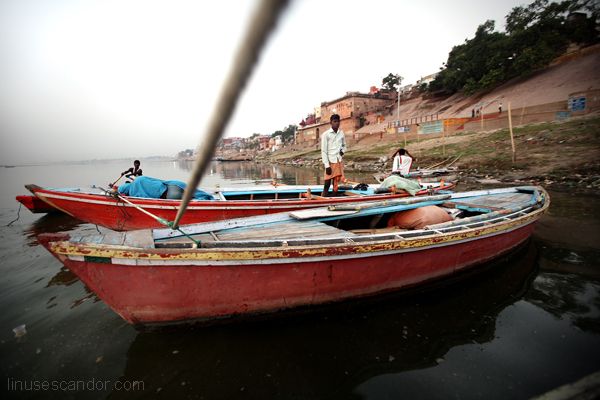
After a long and arduous sixteen hours overnight train journey we reached the great Hindu city of Varanasi. Also known as Baranas or Benares, it stretches along the crescent of the River Ganges, its waterfront dominated by long flights of stone ghats where thousand of pilgrims and residents come for their daily rituals.
Washermen are seen washing clothes on the banks of river Ganges in the northern Indian city of Varanasi.
One of the highlights of the trip in Varanasi is the early morning boat ride along the River Ganges. From here you can see people bathing in the riverbanks. Century old pavilions and palaces, temples and terraces lined up with stone steps – the ghats – stretched along the whole waterfront, changing dramatically in appearance with the seasonal fluctuations of the river level.
Hindus regard the Ganges as amrita, the elixir of life, which brings purity to the living and salvation to the dead, but in reality the river is so polluted and full of effluent. Factory wastes increases the level of heavy metals to unacceptable proportion not to mention the floating human body parts.
A man fishes at the banks of river Ganges in the northern Indian city of Varanasi.
Known to the devout as Kashi, the Luminous – the City of Light, founded by Shiva – Varanasi is one of the oldest living cities in the world. It has maintained its religious life since the sixth century BC in one continuous tradition, in part by remaining outside the mainstream of political activity and historical development of the subcontinent.
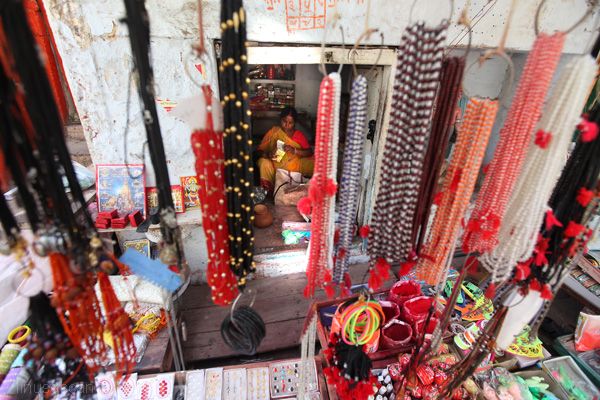
Assorted collection of beads, imitation jewelries are for sale along the gath.
Varanasi is among the holiest of all tirthas that allow the devotee access to the divine and enable gods and goddesses to come down to earth. 
Anyone who dies in Varanasi attains instant moksha or enlightenment. Widows and the elderly come here to seek refuge or to live out their final days, finding shelter in the temples and assisted by alms given by the faithful.


Part 3 Agra

Thursday, May 14, 2009

Amazing Journey to Incredible India - AGRA (Part 3)

Women wearing colorful saris outside the main entrance of Taj Majal, Agra India.
Agra is the capital of India under the Mughals, the splendor of which remains undiminished, from the massive fort to the magnificent Taj Mahal. It is the third apex of the “Golden Triangle”, India’s most popular tourist itinerary, along with Delhi and Jaipur in Rajasthan. Agra’s greatest days arrived during the reign of Akbar the Great, with the construction of Agra Fort. It is majestically built along the bend of the Yamuna River and is made of red-sandstone. His grandson, Shah Jahan, on the other hand built the Taj Mahal in memory of his wife Mumtaz Mahal (“Chosen One of the Palace”) who died shortly after giving birth to her fourteenth child.
Kids crossing the Yamuna river, Agra India.
Agra is the capital of India under the Mughals, the splendor of which remains undiminished, from the massive fort to the magnificent Taj Mahal. It is the third apex of the “Golden Triangle”, India’s most popular tourist itinerary, along with Delhi and Jaipur in Rajasthan. Agra’s greatest days arrived during the reign of Akbar the Great, with the construction of Agra Fort. It is majestically built along the bend of the Yamuna River and is made of red-sandstone. His grandson, Shah Jahan, on the other hand built the Taj Mahal in memory of his wife Mumtaz Mahal (“Chosen One of the Palace”) who died shortly after giving birth to her fourteenth child.
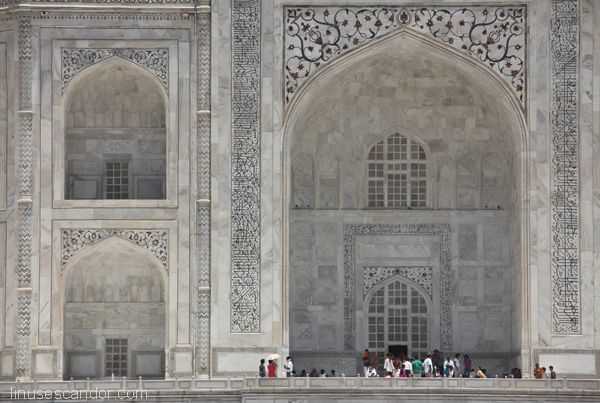
The purest white marble, inlaid with mosaics of precious stones of the walls of Taj Majal, Agra India.
The magic of the monument is strangely undiminished by the crowds of tourists who visit, as small and insignificant as ants in the face of the immense mausoleum. That said, the Taj is as it’s most alluring in the relative quiet of early morning, shrouded in mist and bathed with a soft red glow. As its vast marble surfaces fall into shadow or reflect the sun, its color changes, from soft grey and yellow to pearly cream and dazzling white. This play of light is an important decorative device, symbolically implying the presence of Allah, who is never represented in physical form.

Part 4 Jaipur

Tuesday, May 12, 2009

Amazing Journey to Incredible India - JAIPUR (Part 4)

Our next trip brings us to the state of Rajasthan. The extravagant palaces, forts and finely carved temples comprise one of the country’s richest crops of architectural monuments. Rajasthan’s strong adherence to the traditions of the past is precisely what makes it a compelling place to travel. Swaggering moustaches, heavy silver anklets, colored turbans, pleated veils and mirror-inlaid saris may be part of the complex language of caste, but to most outsiders they epitomize India at its most exotic.
Indian women carrying heavy loads at a busy market in Jaipur, Rajasthan India.
At the heart of Jaipur lies the Pink City, the old walled quarter, whose bazaars rank among the most vibrant in Asia, renowned above all for hand-dyed and embroidered textiles and jewelry. Enclosed by walls and imposing gateways which were designed to offer it some measure of protection against hostile forces, and which still serve to physically demarcate it from the modern suburbs around.
We explored it on foot and bought some souvenirs for love ones at home.Rising from the center of the Pink City is the slender Iswari Minar Swarg Suli, whose summit offers the definitive view of old Jaipur, with fascinating glimpses down into the tangled labyrinth of alleyways and courtyards. The minaret was built by Jai Singh II’s son and successor Iswari Singh, who erected this excessively grandiose monument to celebrate his army’s minor victory over a combined Maratha-Rajput force in 1747.
A view from Nahagarh Fort on the edge of the Aravalli Hills, overlooking the Pink City of Jaipur, Rajasthan.
Teetering on the edge of the hills north of Jaipur is Nahargarh, or “Tiger Fort”. An eye catching structure, the main reason for visiting is to sample the superb views of Jaipur, best enjoyed towards dusk. The imposing walls of the fort sprawl for the best part of a kilometer along the ridgetop, although the significant surviving structures within are the palace apartments. Vehicles of any kind can only get to the fort along a road that branch off Amber Road, a fifteen kilometer journey from the city proper. It is simpler to walk to the fort along the steep path that climbs up from the north side of the city centre, a stiff fifteen-twenty minute walk, although the path is a bit tricky to find.
A drunk man seen sleeping in front of Nawa Majal “Palace of Winds” Palace in Jaipur India.

Part 5 Jaisalmer

Thursday, May 7, 2009

Amazing Journey to Incredible India - JAISALMER (Part 5)


Magical Sunset at the golden sand of Jaisalmer, India.

In the remote westernmost corner of Rajasthan, Jaisalmer is the quintessential desert town, its sand-yellow ramparts rising out of the arid Thar like a scene from the Arabian Nights. It is popularly known as India’s “Golden City” because of its yellow sandstone architectures. The streets of Jaisalmer are flanked with numerous pale honey-colored facades, covered with lattice work and floral designs, but the city’s real showpieces are its havelis, or elaborately decorated mansion.
A boy walks through the sand dunes of Badabagh, Jaisalmer India.

Jaisalmer provides an irresistibly romantic chance to cross the barren sands and sleep under one of the starriest skies in the world. As arranged we just left some of our things in the hotel and after lunch we prepared on our trip to the great Thar Desert. We departed at 3PM and planned to return the next day at noon. We are heading to Sam, about 40 kilometers west of the town. A jeep ride will brought us inner into the desert before riding the camels.


On our way we were caught in the middle of a sandstorm for 15 minutes that seemed like an eternity. That was the first time we all experienced something like that. It was cold and scary but thrilling also. It was followed by a rain which according to our guide was the first time in three years.
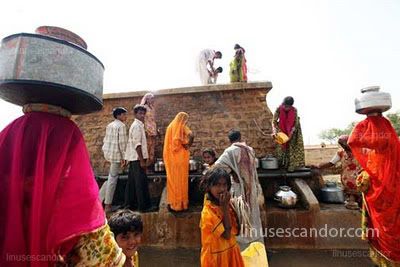
Rajasthani women fetching water from a well in Jaisalmer , India.

The barren desert terrain around Jaisalmer harbors some unexpected monuments, dating back from the Rajput era when the area lay on busy caravan routes. Six kilometers north of Jaisalmer, in the fertile area of Bada Bagh, a cluster of cenotaphs built in memory of Jaisalmer’s rulers stands mighty on a hill amidst a cluster of modern wind turbines. The green oasis below is where most of the area’s fruit and vegetables used to be grown.

Part 6 Manali

Tuesday, May 5, 2009

Amazing Journey to Incredible India - MANALI (Part 6)

Indian women carrying heavy loads of grass feeds in Manali, India.

Himachal’s main tourist resort, Manali, stands at the head of the Kullu Valley. Despite lying at the heart of the region’s highest mountain range, it remains easily accessible by road from the plains. It is a hill station situated at a height of 2050 meters ASL in the Himalayas. Situated on the Beas River, it is a popular tourist spot for Indians in summer and a magical, snow-covered place in winter. This is a very good place to chill out and relax. It has become increasingly popular with domestic tourist, giving rise to an eclectic mix of honeymooners, holiday makers, hippies, trekkers and traders.

Young schoolchildren taking a break at Himachal Pradesh, Manali India.

The Kullu Valley’s spectacular alpine scenery makes it perfect for trekking. Trails are long and steep, but more than repay the effort with superb views, varied flora and the chance to visit remote hill stations. Within striking distance of several major trailheads, Manali is the most popular place to begin and end treks. Other adventure sports worthy of trying in Manali are paragliding, mountain biking, skiing and rafting to name a few.Another place with spectacular views is the Solang Valley.


It is known for its summer and winter sports. The sports most commonly offered are parachuting, paragliding, skating and zorbing. Giant slopes of lawn comprise Solang Valley and provide it its reputation as a popular ski resort. A few ski agencies offering courses and equipment reside here and operate only during winters. Worthy of visiting also is Manali’s oldest shrine, the Hadimba Temple.Our stay in Manali was cut short by the influx of many domestic tourists making the streets and the town congested with people. This time we want some peace and quiet and the best thing to do is go to a place where we can achieve that. Mcleod Ganj in Dharamsala is the recommended location for us. Getting there means we had to endure an overnight bus trip once again through rugged and winding mountain roads.

Part 7  Mcleud Ganj

Friday, May 1, 2009

Amazing Journey to Incredible India - MCLEOD GANJ (Part 7)

McLeod Ganj is one of those places where sitting, chatting and philosophizing in restaurants is the favored activity. Tibetan dishes such as thukpa and momos are prominent, along with Chinese egg noodles, chow mein and stir-fry. Fresh baked Tibetan breads and cakes are widely available. The focal point of McLeod Ganj is its Bhuddist temple, ringed with spinning red and gold prayer wheels. Other Buddhist and Tibetan sites in McLeod Ganj include the Namgyal Monastery, the Tibetan Institute of Performing Arts, Gompa Dip Tse-Chok Ling (a small monastery), the Library of Tibetan Works and Archives, Gangchen Kyishong, Mani Lakhang Stupa, Nechung Monastery, Norbulingka Institute.

Tibetan Prayer flags at Himachal Pradesh mountains.

Home to the Dalai Lama and the Tibetan government in exile and starting point for some exhilarating treks into the Himalayas, Dharamsala, or more correctly, its upper ttown McLeod Ganj, is one of Himachal’s most irresistible destinations. Spread across wooded ridges beneath the rock faces of the Dhauladar Range, the town is divided into two distinct and separate sections, separated by twisting road and almost a thousand meters in altitude. Originally a British hill station, McLeod Ganj has been transformed by the influx of Tibetan refugees fleeing from their homeland. Tibetan influence here is very strong as evidence of temples, schools and monasteries. Many people visit India specifically to come here, and its relaxed and friendly atmosphere can make it a difficult place to leave.

Prayer Wheels pushed by an old woman at McLeod Ganj, Northern India.

Leaving this beautiful and serene place made us sad but we have to. We scheduled to go back to Delhi and endure the blistering heat once again. We had no other choice since our flight going back home is in there. Our stay in India is enough having visited a lot of places already. It’s not possible to see everything India has to offer in a single expedition, and we don’t suggest you try. We have covered a total distance of approximately more than 4,000 kilometers spread across seven cities in four states and seeing places you only see in books.
Rohtang Pass is a high mountain pass of the Himalayas some 51 km from Manali. It connects the Kulu Valley with the Lahaul and Spiti Valleys of Himachal Pradesh, India.

Even with all the beautiful places and interesting people we met there is also the downside of traveling in India. Rampant commercialism, hustling merchants, persistent touts and scams to make you scream with annoyance are just some to name a few. You have to have a strong guts and feeling before you decide to travel in this subcontinent.


Amidst the hassle and some disappointments, our trip in India can be described in two words, simply amazing. I never thought we can actually do this with our tight budget and limited time. You just have to enjoy every minute of it. The train travel, monuments and forts, the spicy foods and the people we met, all this add up to an experience that I will cherish for a lifetime. Every click of my camera captured the best life has to offer giving me more reason to practice and enhance my craft for the next generation to see. We came home not only with a hard drive full of memories but with a contented heart and a brand new outlook in life. I hope this experience will inspire many of our countrymen to travel the world and see things in a different perspective so we can appreciate our own country and love it more.

Wednesday, June 18, 2008

Backpacking South East Asia - Saigon (Part 4)


The next time I would cross the border would be to Ho Chi Minh City. I bought an bus ticket for 10USD. The trip from Phnom Penh to Ho Chi Minh City takes about 6 hours. At the proving of Neak Loeung,  around 60km from the capital the bus had to be ferried across the Mekong river.

At Ho Chi Minh City, I settled for an inn with a room that costs 6US Dollars a night with a single bed.  Though I would have preferred a cleaner bathroom at this point in my trip, the room came with cable tv and a fan.  Being in a city once again encouraged me to just kick back and relax, thats why I opted to arrange for a one day package tour just to take a break from the grueling bus rides I have been enduring the past days.  It turned out to be a rainy day tour that's why I decided to keep my lucky streak traveling alone and spend two more nights in Ho Chi Minh City.


The streets of Saigon are teeming with motorcycle riders.  There are scenic bus trips that will take you away from the bustling capital city to My Tho, one of the provinces at Mekong Delta.  I this point I have sort of fallen off the map and I am just aimlessly traveling to nearby towns.

The downside of going on a trip on a free plane ticket is I have to fly in and out of Bangkok.  So I retraced  my steps and found myself once again in the now familiar city of Bangkok.  As usual, instead of going on a tour package,  I decided to explore the area spending my transportation expenses the same way local Thais normally do.  Take for example, a package rate for a one day Ayutthaya  tour costs 450-1,000 Baht.  


However a backpacker can spend as low as 200 baht, which includes a round trip train ride to the province of Ayutthaya for not more than 60 baht, a 40 baht a day bicycle rental, a 3.50 baht to transfer the bike from the train station to the temples.  One should not hesitate to walk to certain temple sites like the Wat Arun (temple of dawn) and Wat Po (reclining Buddha).  Traveling in Thailand would not be complete without visiting the  famous floating market of Damoen Saduak.  


On a tight budget, I got  a two-week adventure in the Southeast, souvenir shirts, a bunch of gift items, a genuine Thai massage, incredible photographs and a wider perspective of the world.

Wednesday, June 11, 2008

Backpacking South East Asia - Phnom Penh (Part 3)

I bought a bus ticket to Phnom Penh for 7USD.  I left Seam Reap lunchtime and reached the capital at 6:28 in the evening,  covering a distance of 251 kilometers.  There where no delays along the way for we only have a stop for a short break.  Phnom Penh's tourist attractions for a tourist visit for there are a handful of tourist spots present.   I stayed in Phnom Penh for 2 days and stayed near the central market in a guest house spending 5US Dollars a night.


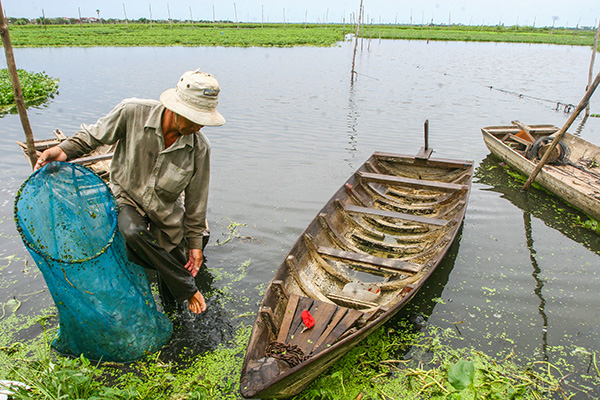
Cambodia’s Tonle Sap Great Lake is the largest freshwater floodplain lake in the world, increasing and decreasing in size annually . It is one of the places or one is with the more meadows of the Kampuchean everyday life and their reality.

One of Phnom Penh famous attractions is the gruesome reminder of the country's past. The famous "Killing Fields" of Cambodia's Cheong EK. Cheong Ek is at least 15 kilometers from the Central Market of Phnom Penh. In 1975 and 1978, as many as 17,000 Cambodians were tortured and killed. The event is immortalized in the movie "The killing fields".

One of Phnom Penh famous attractions is the gruesome reminder of the country's past. The famous "Killing Fields" of Cambodia's Cheong EK. Cheong Ek is at least 15 kilometers from the Central Market of Phnom Penh. In 1975 and 1978, as many as 17,000 Cambodians were tortured and killed. The event is immortalized in the movie "The killing fields".


Monday, June 9, 2008

Backpacking South East Asia - Siem Reap (Part 2)

My journey begins on the following day after my overnight stay at Travelers' Inn for only 5.5US Dollars a night, a small single bed room with a fan. I bought a cheap bus ticket to Siem Reap Cambodia for only 11US Dollars from a popular travel agency along Khao San Road the night before.   A little hunting around resulted in finding what was possibly the most affordable passage to Thailand's neighboring countries.


As a backpacker, my travel intention is to cross the borders in the Southeast on a tight budget. It isn't the luxurious hotels or the rich cuisine that I am after. For me, the experience of capturing the grandeur of any new place in a photograph is the ultimate reward in itself.   Stories of scammed tourist abound online.  It isn't uncommon to hear such stories straight from a fellow traveller on a long bus ride to the border. No matter how intimidating or discouraging the stories may be every picture I take only leads me forward as every photograph becomes richer and more interesting. 


Any thought of taking the easier route is overshadowed by the nagging thought that every picture is going to come out better than the last.  


There are three ways to the border of Aranyaprathet, Thailand, by taxi, bus and train. I opted to take the bus because for me it is more relaxing and the fare is rather affordable.  Aranyaprathet is 300 kilometers from Bangkok.  Our bus left Khao San Road at 8:00 in the morning.  


The road is a paved highway and the journey to the border is scenic enough to keep the mind pleasantly pre-occupied, keeping the boredom at bay during the four-hour ride.  The bus ride ends a few meters before the Thai border and the driver inform us to transfer to another big bus which will take us across the border of Cambodia which is Poipet.


Everyday thousands of Cambodians and Thais cross the border. On a rainy season there are not western tourists.  The trip from  Poipet to Siem Reap is a bumpy one because of the partially constructed highway damaged by the rain and mud.   Such slow progress took the bus six hours to reach Seam Reap, the sight of the magnificent temples of Angkor.


I arrive in Seam Reap with a couple of buddies I met on the bus.  Henry, a Korean from San Diego, USA, and Killian from Germany. I spend the night at the Golden Village guesthouse for only 6US Dollars, a fan-bungalow hut with a clean toilet, a washroom and a mosquito net.  What  amazes  me most about this lodge was the internet use is for free and there were 5 working computer units for travelers to use. The next day the three of us arranged for a tuktuk (a popular 3 wheeled taxi type ride in Bangkok and  Cambodia) to take us around the temples of Angkor for 10 US dollars a day, the cost to be divided among the three of us.


Seam Reap is famous for the hundreds of temples of Angkor built by ancient Khmer empire. Visitors have three choices to visit the temples: 20USD for a day pass, 40USD for two day to three day pass and 60USD for a week pass. I paid 40US Dollars for a two-day pass which is enough for me to take pictures of the beauty of Angkor.  


I stayed in Seam Reap taking pictures of the temples Angkor Wat, Ta Phrom, the Bayon and other temples.  While in Siem Reap I rented a bike for 2 US Dollars a day and enjoyed the sights along its streets.  My next stop is Phnom Penh, the capital of Cambodia. 

Thursday, June 5, 2008

Backpacking South East Asia - Thailand (Part 1)

It all started by a free round-trip free ticket to anywhere in South East Asia. What I didn't realize was it was enough to go on in an adventure of a lifetime. I picked Khao San Road to begin my journey. What would be more fitting than to head first to what is considered as the mecca for travelers?

Khao San road is a short road in central Bangkok, Thailand.  It is located in the Banglamphu neighborhood about 1 kilometer from the Grand Palace with Wat Phra Kaew.   It has developed over the years into most probably the most profound worldwide example of a "backpacker's ghetto".

This isn’t exactly taking the road less travelled which is more befitting of a backpacker like myself, but I have chosen Khao San Road out of curiosity having read about its supposed popularity among Western tourists. Many tourists prefer to stay on this short road because of the affordable accommodations and proximity to some of Thailand’s famous temples.


Hua Lamphong Railway Station ( Bangkok Railway Station ) is the main railway station in Bangkok Thailand.

Though there are several cheap and affordable tour packages available for travelers to explore Thailand’s neighboring countries like Cambodia, Vietnam and Laos, I prefer the challenges of traveling alone not just on planning and discovering itineraries as I go but also of budgeting and making the most of every buck. Of course it also allows me to take as much time in any place taking pictures as much as I want and getting to know the locals.


Damoen Saduak has a daily floating market and is located 100km. from Bangkok Thailand.

Damoen Saduak has a daily floating market and is located 100 kilometers from Bangkok, Thailand.  The traders sit in their boats and sell their goods and other food products to people living in the houses as well as to each other.


I am always conscious of following the old cliche that I must be a traveller and not a tourist.
My journey begins on the following day after my overnight stay at Garden Village  lodge for only 2.5 USD a night in a cool dormitory room with a personal fan. The guesthouse is popular amongst the tourists because of the warm accommodation and hospitality. I bought a cheap bus ticket to Seam Reap Cambodia for only 11USD along Kao San Road the night before. A little hunting around resulted in finding what was possibly the most affordable passage to Thailand's neighboring country Cambodia.