Showing posts with label Rajasthan. Show all posts

Tuesday, May 12, 2009

Amazing Journey to Incredible India - JAIPUR (Part 4)

Our next trip brings us to the state of Rajasthan. The extravagant palaces, forts and finely carved temples comprise one of the country’s richest crops of architectural monuments. Rajasthan’s strong adherence to the traditions of the past is precisely what makes it a compelling place to travel. Swaggering moustaches, heavy silver anklets, colored turbans, pleated veils and mirror-inlaid saris may be part of the complex language of caste, but to most outsiders they epitomize India at its most exotic.
Indian women carrying heavy loads at a busy market in Jaipur, Rajasthan India.
At the heart of Jaipur lies the Pink City, the old walled quarter, whose bazaars rank among the most vibrant in Asia, renowned above all for hand-dyed and embroidered textiles and jewelry. Enclosed by walls and imposing gateways which were designed to offer it some measure of protection against hostile forces, and which still serve to physically demarcate it from the modern suburbs around.
We explored it on foot and bought some souvenirs for love ones at home.Rising from the center of the Pink City is the slender Iswari Minar Swarg Suli, whose summit offers the definitive view of old Jaipur, with fascinating glimpses down into the tangled labyrinth of alleyways and courtyards. The minaret was built by Jai Singh II’s son and successor Iswari Singh, who erected this excessively grandiose monument to celebrate his army’s minor victory over a combined Maratha-Rajput force in 1747.
A view from Nahagarh Fort on the edge of the Aravalli Hills, overlooking the Pink City of Jaipur, Rajasthan.
Teetering on the edge of the hills north of Jaipur is Nahargarh, or “Tiger Fort”. An eye catching structure, the main reason for visiting is to sample the superb views of Jaipur, best enjoyed towards dusk. The imposing walls of the fort sprawl for the best part of a kilometer along the ridgetop, although the significant surviving structures within are the palace apartments. Vehicles of any kind can only get to the fort along a road that branch off Amber Road, a fifteen kilometer journey from the city proper. It is simpler to walk to the fort along the steep path that climbs up from the north side of the city centre, a stiff fifteen-twenty minute walk, although the path is a bit tricky to find.
A drunk man seen sleeping in front of Nawa Majal “Palace of Winds” Palace in Jaipur India.

Part 5 Jaisalmer

Thursday, May 7, 2009

Amazing Journey to Incredible India - JAISALMER (Part 5)


Magical Sunset at the golden sand of Jaisalmer, India.

In the remote westernmost corner of Rajasthan, Jaisalmer is the quintessential desert town, its sand-yellow ramparts rising out of the arid Thar like a scene from the Arabian Nights. It is popularly known as India’s “Golden City” because of its yellow sandstone architectures. The streets of Jaisalmer are flanked with numerous pale honey-colored facades, covered with lattice work and floral designs, but the city’s real showpieces are its havelis, or elaborately decorated mansion.
A boy walks through the sand dunes of Badabagh, Jaisalmer India.

Jaisalmer provides an irresistibly romantic chance to cross the barren sands and sleep under one of the starriest skies in the world. As arranged we just left some of our things in the hotel and after lunch we prepared on our trip to the great Thar Desert. We departed at 3PM and planned to return the next day at noon. We are heading to Sam, about 40 kilometers west of the town. A jeep ride will brought us inner into the desert before riding the camels.


On our way we were caught in the middle of a sandstorm for 15 minutes that seemed like an eternity. That was the first time we all experienced something like that. It was cold and scary but thrilling also. It was followed by a rain which according to our guide was the first time in three years.
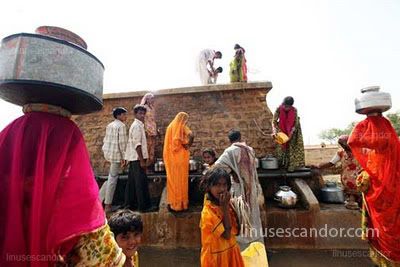
Rajasthani women fetching water from a well in Jaisalmer , India.

The barren desert terrain around Jaisalmer harbors some unexpected monuments, dating back from the Rajput era when the area lay on busy caravan routes. Six kilometers north of Jaisalmer, in the fertile area of Bada Bagh, a cluster of cenotaphs built in memory of Jaisalmer’s rulers stands mighty on a hill amidst a cluster of modern wind turbines. The green oasis below is where most of the area’s fruit and vegetables used to be grown.

Part 6 Manali